Preserving Georgia's hidden heritage
Join the Society for Georgia Archaeology! Help save Georgia's fast-disappearing past, and learn about it at the same time. The SGA's members are avocational and professional archaeologists, along with the interested public.
The Society meets twice a year, in the spring and fall, at locations that rotate around the state. The spring meeting is in conjunction with Archaeology Month, in May. Meetings are open to the public.
Bookmark this page, and read news of interest to members of the SGA. At least one story is posted here each week, and often more.
Whatever is iron gall ink? Parchment is a common term, but what is that ink? Colonial-period documents were commonly written in iron gall ink. Georgia’s copy of the Declaration of Independence was. Even Bach and Da Vinci used it! Read more about this ink in the full story. Find out how many kinds of trees it takes to make the ink, too!
[More]
Dr. Vincas Steponaitis will deliver the keynote address at the 36th Annual Conference of the Archaeological Society of South Carolina (South Carolina’s version of the Society for Georgia Archaeology) on Friday, April 9th, in the Business School Auditorium, Room 005, on the University of South Carolina campus in Columbia. Read more about this meeting, and the call for papers, in the full story.
[More]
The Augusta Archaeological Society’s February speaker will be Robert W. Benson. The meeting will be at the Flyin’ Cowboy Restaurant, 2821 Washington Road, Augusta, on Thursday February 4th, at 6:30 pm. Also, the February issue of the AAS newsletter, Debitage, is now available.
[More]
At their February meeting, Greater Atlanta Archaeological Society members will hear a presentation by Scot Keith about the Leake Site, a primarily Middle Woodland mound and village site, which is near Cartersville and the Etowah Mounds. The meeting is Tuesday, February 9th. The presentation begins at 7:30, and Scot will have some artifacts you can look at if you arrive early!
[More]
The Society for American Archaeology recently announced that their newsletter, published five times each year, is available in a new format for reading online beginning with the 2010 issues, and also is downloadable.
[More]
Perhaps you watched Steve Jobs and other Apple people introduce the iPad on 27 January 2010…. Fans of archaeology might have noted that one of the major demonstrations, of the program Keynote, used the topic “Seven Wonders of the World,” which focused on selected archaeological sites. What does it mean that they chose an archaeological topic to punch their high-profile product introduction?
[More]
The SGA invites you to host an Archaeology Awareness event in May 2010! The full story offers great ideas for your event! Schedule an event by submitting the form provided. Read more here….
[More]
State Archaeologist Dr. David Colin Crass is the new Director of the Historic Preservation Division (HPD) of the Georgia Department of Natural Resources (DNR), the DNR announced on 27 January 2010. Dr. Crass came to Georgia HPD twelve years ago.
[More]
Save the date: Saturday, May 15th. Plan to meet SGA members and other interested attendees at The Parks at Chehaw just outside of Albany. Read the full story and stay tuned to this website for more details!
[More]
Historical archaeologists can use data from historical records, which are unavailable to archaeologists working with prehistoric data. How does that make a difference? This issue is examined using notes made by French historian Alexis de Tocqueville in 1831 in a letter to his mother, which has only recently been published in English translation.
[More]
This story marks the first year of Weekly Ponder posts! Yes, it’s been a full year of 5am Friday postings of thought-provoking articles to this website. Indeed, the very first Weekly Ponder was posted on 26 January 2009.
[More]
Burke County State Court Judge Jerry Daniel in January handed down heavy fines on four east Georgia men who pled guilty to multiple counts related to looting a Late Archaic, Stallings culture shell midden site on the Ogeechee River in southern Burke County. The four men were apprehended on private land by Georgia Department of Natural Resources Ranger First Class Jeff Billips and Ranger First Class Grant Matherly in late September 2009.
[More]
Frank T. Schnell, a Columbus native and long-time SGA member, died Monday, 18 January 2010 after he fell from a ladder. He is survived by his wife, Gail, who also is an SGA member.
[More]
The Bartow History Museum in downtown Cartersville invites you to visit! The Museum has interactive exhibits and also hosts monthly lectures. Road trip: combine a trip to the Etowah Mounds and a visit to this Museum!
[More]
An international working group called INTCAL has announced an updated radiocarbon calibration curve based on cross-checking thousands of tree-ring samples with raw radiocarbon dates. The new curve is available online.
[More]
Quick: what is the only installation built by the United States military during the settling of the interior of the continent to protect Indians from Indians (rather than settlers from Native Americans)?
[More]
Read the full story for one example of how archaeologists use indirect data to aid in generating a more complex and detailed understanding of the past. In this example, archaeologists from the University of Sheffield report on their successes using data on weeds to assist in their understanding of crop husbandry on a few archaeological sites in the Middle East.
[More]
The Human Spark is a three-part series investigating the topic of human uniqueness hosted by Alan Alda. One of the interviewees, Dr. Veronica Waweru, discusses the pros and cons of arrow and spear use, along with other interesting topics, in a blog entry associated with the program’s web pages.
[More]
In mid-December 2009, Secretary of the Interior Ken Salazar announced that the National Park Service is awarding $46.5 million in historic preservation grants to 59 states and U.S. territories. However, nine states will receive more than $1 million each, leaving just under $35 million for the other states and non-states. Georgia’s piece of this historic preservation pie? Read the full story for more details.
[More]
George S. Lewis, a very active member of the Augusta Archaeological Society and the Society for Georgia Archaeology, wrote a history of the AAS in July 1989. Titled “A Brief History of the Augusta Archaeological Society,” this document is now available in PDF form.
[More]
On 27 December 2009, the online version of Charleston’s Post and Courier published a fascinating story by Tony Bartelme titled “Research on Hunley spurs new discoveries.” The new discoveries relate to faster methods for preserving metal artifacts, like the H.L. Hunley Confederate Civil War submarine, which sunk near Charleston in February 1864.
[More]
Published in spring 2009, Richard Wrangham’s book Catching Fire: How Cooking Made Us Human (Basic Books) argues that the ability to use fire for cooking foodstuffs allowed the changes that have made humans a distinct species. What do you think of this argument? Read more about the book and Wrangham’s hypothesis in the full story.
[More]
Greenspace projects involve lands set aside to remain undeveloped. In cities, publicly owned greenspace is often in parks. The central purpose of greenspace is to assure that some terrain remains protected from construction, paving, and other development. In short, it will remain “green.” Preservation of greenspace often means the preservation of archaeological sites. How does that happen?
[More]
Archaeologist Scot Keith reports on the Leake site, which is west of Cartersville in Bartow County not far from the Etowah Mounds site, and partly within the right-of-way of Highways 61/113. The site has been named to the 2010 Georgia Trust for Historic Preservation’s Places in Peril listing, which will aid Keith and others to raise money to protect the remaining portions of this important Woodland and Mississippian site. The full story includes excellent aerial photographs.
[More]
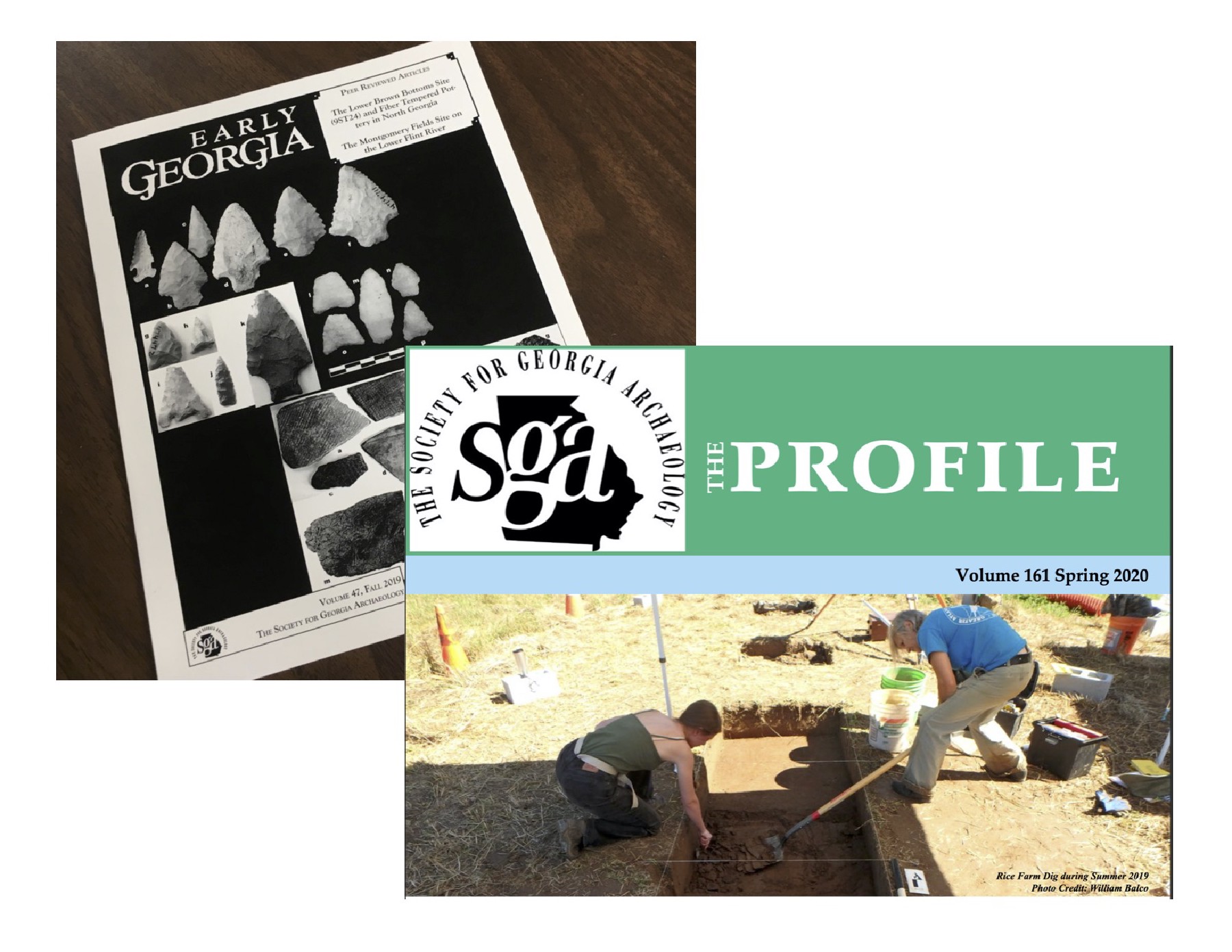
Download number 143, the Fall-Winter 2009 issue of The Profile, the newsletter of the Society for Georgia Archaeology, by going to the full story.
[More]
In the full story, The Profile Editor Larissa Thomas discusses publication issues, and notifies the membership that she is stepping down as editor, and asks for a volunteer to take over this important position.
[More]
Long-time SGA supporter Rita Elliott discusses the perfect gift: a donation to the SGA’s endowment fund! (Psst, and it’s tax deductible!)
[More]
Researchers at Hunter Army Airfield in Savannah identified two historic-period cemeteries. One had been buried beneath a parking lot for over fifty years; it had thirty-seven graves. A second cemetery was identified from an 1889 map as a “Negro Cemetery,” and had well over three hundred burials. All human remains and artifacts were carefully excavated and respectfully moved to Belmont Cemetery, and the Installation’s Garrison Commander and Chaplain participated in a rededication ceremony in conjunction with African-American History Month in February 2009. Article includes photographs of selected grave goods.
[More]
Archaeological crews from the American Museum of Natural History have been excavating on St. Catherines Island for over 30 years. Research this fall focused on the McQueen Shell Ring. Data suggests that the ring was the only substantial Late Archaic presence in this section of St. Catherines Island. (The full story may be slow to load due to a large figure.)
[More]
CoastFest 2009 broke all records for attendance this year with over 7000 visitors. The SGA sent the ArchaeoBus and set up tables, with many volunteers helping educate the visitors. The theme was “Save Georgia’s Dirt!”
[More]
The SGA Fall Meeting was held at the Gwinnett Environmental & Heritage Center on Saturday, October 17th in Buford, with a great panel of presentations. During the Business Meeting, members learned the SGA is seeking volunteers for two important positions: Society Secretary and Editor of The Profile. Please read the full story and let President Dennis Blanton know your thoughts regarding The Profile publication—web only versus a costlier “dead-tree” version.
[More]
The ArchaeoBus wranglers have been busy. During the past six months with few attempts to solicit venues, we have exposed 8,500 people to the Archaeobus and archaeology. Read the full story for a summary of ArchaeoBus activities, and a discussion of funding sources and some volunteers (a hearty thank you to each!) and expenses.
[More]
The National Park Service’s 2010 workshop on archaeological prospection techniques entitled “Current Archaeological Prospection Advances for Non-Destructive Investigations in the 21st Century” will be held May 24–28, 2010, at the Knife River Indian Villages National Historic Site near Stanton, North Dakota. Registration is $475. The full story has a link to the application form and more information.
[More]
Although the Georgia Mountains Archaeological Society (GMAS) in Gainesville is no more, there is a new SGA chapter rising in north Georgia. The Blue Ridge Archaeology Guild (BRAG) is meeting on the third Thursday each month at North Georgia College and State University (NGCSU) at 7:00 pm in Young Hall. Their meetings are in conjunction with the new student club, the North Georgia Archaeology Guild (NoGAG). The two clubs are already busy with hands-on projects.
[More]
Georgia’s Jekyll Island has an interesting past, detailed here. The Island is owned by the the people of Georgia and managed on their behalf by the Jekyll Island Authority. It’s a natural and cultural treasure most of us don’t know enough about.
[More]
The Savannah River Archaeological Research Program is seeking information about prehistoric metavolcanic stone quarries in the Carolina Slate Belt Region in South Carolina. As this map shows, the Carolina Slate Belt Region is prominent in the Carolinas, and extends southward into Georgia.
[More]
A recent Atlanta Journal-Constitution article by Cameron McWhirter discusses the application of modern technologies to Civil War archaeological sites in the Atlanta area. Most of the article stems from an interview with SGA member Garrett Silliman, and also mentions SGA member Dan Elliott.
[More]
The online version of Jacksonville’s The Florida Times-Union published a story on the Society’s own ArchaeoBus on 24 November 2009. Elementary school students sort pottery in this photo by Terry Dickson. Read the full story by clicking [More] below.
[More]
On November 4th 2009, the Georgia Trust for Historic Preservation announced its list of Georgia’s top ten Places in Peril, which includes the Leake Archaeological Site, a rich Middle Woodland and Late Mississippian-period prehistoric settlement on the outskirts of Cartersville. Scot Keith, an archaeologist who lead recent excavations at the Leake Site, notes, “with help from the Georgia Trust for Historic Preservation and numerous volunteers, we will be conducting many activities in the next year (and beyond) to foster public awareness of the site and its important place in history. This will include public education days at the site, community meetings, interviews, articles, partnerships and grants, research and fieldwork, and regular website updates.”
[More]
Georgia’s Mobile Archaeology Classroom—the ArchaeoBus—provides hands-on and minds-on activities to enthuse your students about learning. Archaeology is a great tool for turning on the minds of students, as well as a great motivational tool. More important, it is a discipline capable of instruction in a wide variety of skills. Archaeology is a holistic academic and intellectual approach that involves all subject areas, social skills, and conceptual skills. Georgia’s Mobile Archaeology Classroom offers the opportunity for students and teachers to leave the traditional four-walled classroom and use a new approach to learn state standards!
[More]
Preservation Georgia Online for September 12–18, 2009, lists the four grants funded through statewide preservation license tag sales. The four SFY 2010 Georgia Heritage Grants total $46,285.
[More]
The complete archive of online news on various topics in archaeology is here, listed in reverse order of publication on this website. If, instead, you are interested in an archive of notices about the business of the Society (e.g., preparations for meetings), click here.
[More]